Tyson Ray
I am a college student studying Aeronautical Engineering entering my junior year. I am currently further exploring Guidence, Navigation, and Control through my undergraduate research, internship, and personal portfolio.

I am a college student studying Aeronautical Engineering entering my junior year. I am currently further exploring Guidence, Navigation, and Control through my undergraduate research, internship, and personal portfolio.
GPA: 3.6 · Relevant coursework: Thermodynamics, Differential Equations, Aerodynamics.
Description of your key responsibilities and accomplishments in this role.
Description of your key responsibilities and accomplishments in this role.
An overview of your research interests, ongoing projects, and published or in-progress work. Update this section with your actual focus areas.
Brief description of the research problem, your approach, and expected outcomes or impact.
Brief description of the research problem, your approach, and expected outcomes or impact.
Brief description of the research problem, your approach, and expected outcomes or impact.
Describe what you worked on, technologies or tools used, and the impact of your contributions during this internship.
Describe what you worked on, technologies or tools used, and the impact of your contributions during this internship.
A selection of projects I've built or contributed to. Each one reflects a problem I found interesting and wanted to solve.
A 1.78 m flying wing designed from scratch: vortex-lattice stability analysis, carbon-spar structure sized to +6 g, 26-part 3D-printed airframe, and ArduPilot avionics. Full write-up on the UAV Project page →
Short description of what the project does, the problem it solves, and any notable results or metrics.
Short description of what the project does, the problem it solves, and any notable results or metrics.
Short description of what the project does, the problem it solves, and any notable results or metrics.
A custom unmanned aircraft designed from a blank sheet — aerodynamics, stability and control, composite structure, manufacturing, and avionics — built as a hands-on platform for the guidance, navigation, and control work I want to do as a career. Nothing started from an existing airframe: every dimension traces back to an analysis I ran and can defend.
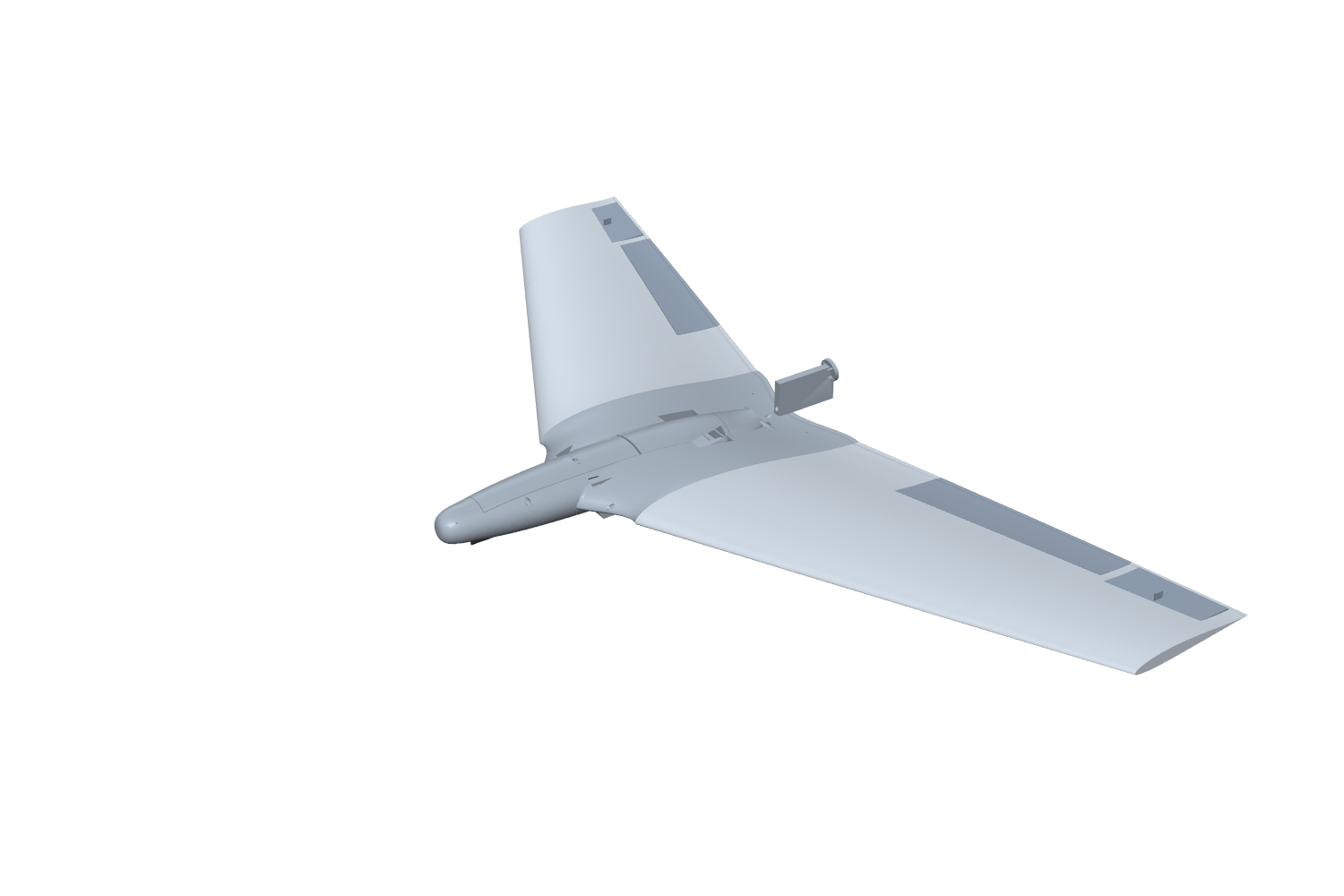
The flying wing packs the most volume into the smallest airframe, but it gives up the easy stability of a tail — pitch trim, yaw control, and CG placement all have to be engineered deliberately. That trade is the whole point. The aerodynamics were sized in a Python pipeline (vortex-lattice + neural-network airfoil models): it locates the neutral point, places the CG for an 8% static margin, and solves the cruise trim. Carbon-fiber tube spars are sized from a spanwise load analysis at +6 g, and a fully parametric CAD model exports 26 watertight, print-fit-checked parts.
Avionics: Cube Orange+ / Kore carrier on ArduPilot, Here3+ GNSS, ExpressLRS control link, 915 MHz telemetry to a laptop ground station. The flight-test program ends by comparing the stability derivatives measured in flight against the ones this analysis predicted — the core loop of GNC engineering.